

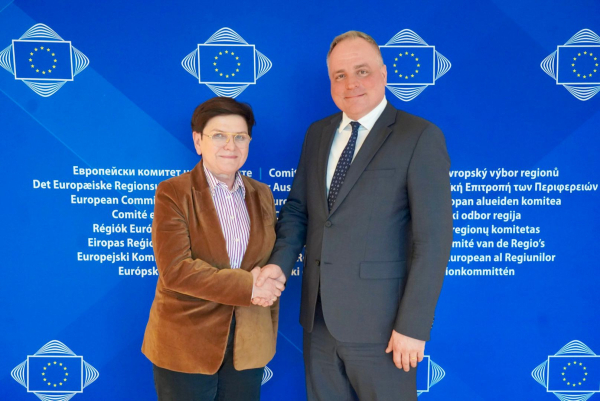
The European Committee of the Regions’ Commission for Territorial Cohesion Policy and EU Budget (COTER) adopted today the Connecting Europe Facility 2028-2034 opinion by ECR Vice-President Juraj Droba. The opinion emphasises the crucial role of the CEF in supporting Europe’s transport and energy networks and strengthening the EU’s competitiveness, security, and Single Market integration. Present at the debate, ECR Group MEP Beata Szydło , European Parliament shadow rapporteur on Connecting Europe Facility regulation, who contributed with her work on the file.
The European Commission’s proposed EUR 81 billion budget for CEF 2028–2034 represents a substantial increase compared to the current programming period. This ambitious envelope underscores the growing relevance of the programme, particularly as Europe faces mounting infrastructure, security and territorial cohesion challenges.
"Regions and cities are essential actors in planning, permitting and operating infrastructure, and must therefore be systematically involved in the programme’s design, implementation, governance and monitoring" said Vice-President Droba who underlined the need for further investments across the Trans-European Transport and Energy Networks (TEN-T and TEN-E).
Vice-President Droba pointed to the CEF’s tangible impact on the ground, including major cross-border rail upgrades between Bratislava and Brno, which will dramatically reduce travel times once completed. The draft opinion calls for reintroducing urban nodes among the specific objectives of the programme, and stresses the strategic importance of military mobility, with the new CEF proposal multiplying funding tenfold in response to today’s security environment and the impact of Russia’s aggression against Ukraine. "For many regions and cities —especially those along EU borders — this represents a major opportunity to reinforce dual-use infrastructure", said Mr Droba.
"CEF investments have far-reaching consequences for local and regional development. With this opinion we call for a stronger role for local and regional authorities in the regulation to ensure that the programme fully reflects territorial needs", he concluded.
The opinion will be voted by the Plenary of the CoR on the 6th and 7th of May.