

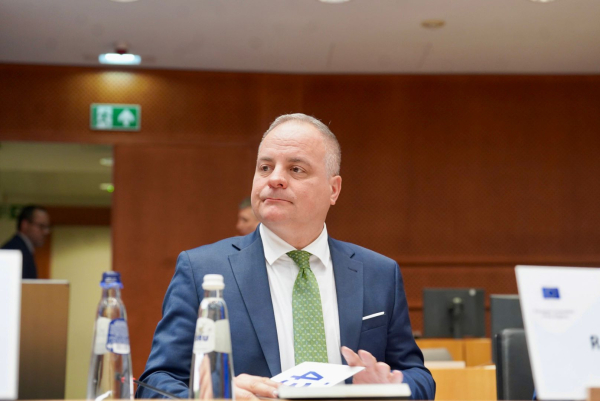
The European Committee of the Regions has adopted ECR Rapporteur Juraj Droba's opinion on the future of the Connecting Europe Facility (CEF) during the Plenary session, sending a strong political message on the need to reinforce the territorial dimension of one of the EU’s key infrastructure funding programmes. The discussion saw the presence of European Parliament Vice-President Antonella Sberna, who is also and rapporteur for the CEF in the REGI Committee in the Parliament.
Presenting his opinion in the hemicycle, the President of the Bratislava Region and ECR Vice-President, stressed that the CEF 2028-2034 represents a crucial opportunity to better reflect Europe’s diverse territorial needs, ensuring that regions and cities play a stronger role in shaping and implementing major transport and energy projects. “I see the Connecting Europe Facility as a great opportunity for regions and cities,” the rapporteur said, highlighting that with a proposed budget of €81 billion, CEF can significantly strengthen Europe’s connectivity and resilience in a rapidly changing geopolitical context.
European Parliament Vice-President Antonella Sberna: "In the REGI Committee, we stressed that a project has European value even when it solves a national bottleneck. It is not enough to finance a major corridor if access to ports remains uncovered. It is not enough to design a TEN-T network if there is no connection to the hinterland. It is not enough to talk about a single market if some regions remain isolated or difficult to reach.As we worked on the opinion of the Committee on Regional Development, we have sought to do one thing: to bring the voice of regions, cities and local communities into the CEF."
A key recommendation of the adopted opinion is the reintroduction of urban nodes as a specific objective within the CEF. “Without properly addressing these nodes, we risk weakening the overall efficiency of our networks,” the rapporteur warned, stressing that this is “a key recommendation of the entire opinion” that should be actively promoted among the co‑legislators and the European Commission.
At the same time, the CoR opinion highlights the need for greater flexibility to address geographical constraints, recognising that some regions depend heavily on ports and airports as gateways, while others require stronger support for national segments of the TEN‑T network.
Against the backdrop of the current geopolitical situation, the text also supports increased funding for military mobility, while insisting that investments in dual‑use infrastructure must deliver benefits for both defence and civilian mobility, with regions and cities involved in planning. "By considering territorial specificities and involving regions and cities, we can ensure the programme's successful implementation on the ground, fostering a more connected and competitive Europe", Droba concluded.