

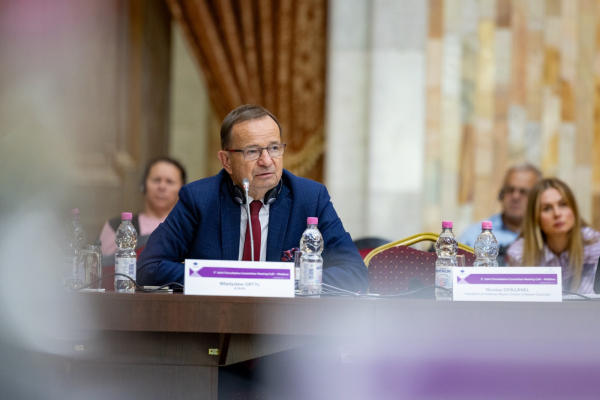
President of the Republic of Moldova Maia Sandu addressed the inaugural meeting of the Joint Consultative Committee between the European Committee of the Regions and Moldova in Chișinău, underlining the importance of local and regional authorities to the country’s European future.
The ECR Group was represented by three Polish members: First Vice-President Władysław Ortyl, Marshal of the Podkarpackie Region, Jarosław Stawiarski, Marshal of the Lublin Region, and Adam Ciszkowski, Mayor of Halinów. They also participated in the 15th Annual Meeting of the Conference of Regional and Local Authorities for the Eastern Partnership, CORLEAP, held in Chișinău on the previous day.
“President Maia Sandu’s participation in the inaugural meeting sent a strong political message: Moldova’s European path must be supported not only at national level, but also in its cities, municipalities and regions,” said ECR First Vice-President Władysław Ortyl. “European integration will succeed when citizens can see its benefits in stronger local institutions, better public services and new opportunities for their communities.”
Drawing on Poland’s experience, Mr Ortyl contributed to the discussion on lessons learned from public administration reform in EU Member States and associated countries. He underlined that Poland carried out its key territorial reform five years before joining the EU, creating stronger self-government and administrative capacity ahead of accession. The debate highlighted that successful reform cannot be based on a single institutional model, but must respect national traditions, territorial realities and local democratic legitimacy.
“Poland’s experience shows that accession requires strong institutions at every level of government,” Ortyl stated. “Responsibilities must be matched by adequate funding, qualified staff and genuine decision-making powers. Decentralisation cannot simply mean transferring additional obligations to municipalities without giving them the tools to deliver. For Poland, strong self-government became one of the foundations of effective EU funds absorption and sustainable regional development.”
The meeting concluded with the endorsement of a Joint Declaration reaffirming support for Moldova’s EU accession and calling for a stronger local and regional dimension in the process.
At CORLEAP, the ECR delegation called for a balanced approach to tackling foreign information manipulation, warning against measures that could restrict legitimate political debate, media scrutiny or freedom of expression. The members argued that local and regional authorities should play a central role in strengthening resilience against disinformation, while independent local media should be supported through greater sustainability, pluralism and protection from political pressure.
"From Ukraine and Moldova to the South Caucasus, the Eastern Partnership region faces a deliberate Russian strategy of interference, disinformation and destabilisation. As local and regional leaders, we have a responsibility to strengthen resilience where it matters most: in our communities and local institutions, where public trust is built every day", Mr Stawiarski said.
ECR representatives also welcomed the launch of the Eastern Partnership Academy for Public Administration, an initiative long supported by former ECR rapporteur Tadeuš Andžejevski, stressing that its success would depend on delivering practical tools, peer-to-peer learning and measurable improvements in local governance. Throughout the debate, the delegation advocated a strong subsidiarity-based approach, ensuring that reforms and capacity-building efforts empower local communities rather than reproduce centrally designed solutions.