

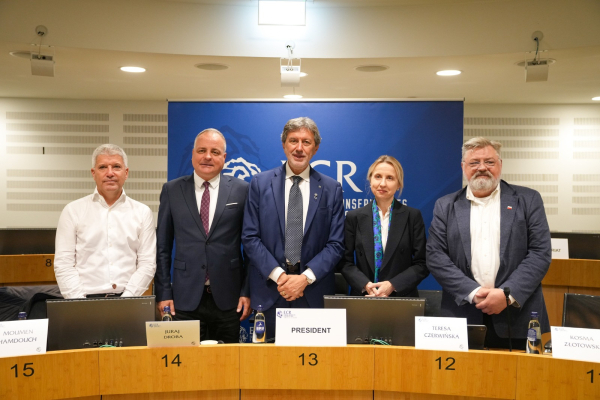
Europe’s transport transition must strengthen competitiveness, connectivity and resilience instead of imposing uniform solutions on regions with widely different needs. This was the key message from ECR representatives and transport stakeholders who came together during the ECR Group workshop as part of the EU Week of Regions and Cities in Brussels.
The event “Towards a competitive and resilient European transport system” brought together policymakers and industry experts to discuss the future of road, rail, air and maritime transport.
With opening remarks from ECR Group President Marco Marsilio, the panel was moderated by ECR Vice-President and President of the Bratislava Region Juraj Droba and featured ECR Group MEP Kosma Złotowski, Petr Dolejsi, Mobility and Sustainable Transport Director at ACEA, former European Investment Bank Vice-President Teresa Czerwińska and Moumen Hamdouch, Head of Unit for Sustainable and Intelligent Transport at the European Commission’s DG MOVE.
The discussion focused on completing the TEN-T network, strengthening conventional and high-speed rail, improving military mobility and supporting alternative fuels. Participants also examined the pressure facing Europe’s automotive industry, including rising costs, global competition and the need to reduce emissions without weakening European production.
"Europe needs a competitive and resilient transport system, not one driven by ideological climate targets. The Green Deal has placed excessive costs on businesses and citizens. We need a pragmatic approach based on technological neutrality, affordable transport and stronger cross-border connections. European policy must strengthen our industry and competitiveness, not undermine them with unrealistic regulations", said Mr Złotowski.
The ECR Group emphasised that rural, inland, and border regions continue to face severe connectivity gaps. Limited access to reliable railways, airports and road connections restricts investment, weakens the Single Market and can force citizens, particularly young people, to leave their communities.
Europe therefore needs a place-based approach that recognises the different infrastructure and mobility needs of its territories. High-speed rail must be connected to conventional and regional networks, while transport policy must remain open to all technologies capable of reducing emissions. Europe will not build resilient transport through bans and one-size-fits-all rules. It will do so by connecting with every region, supporting innovation and allowing practical solutions to compete.