

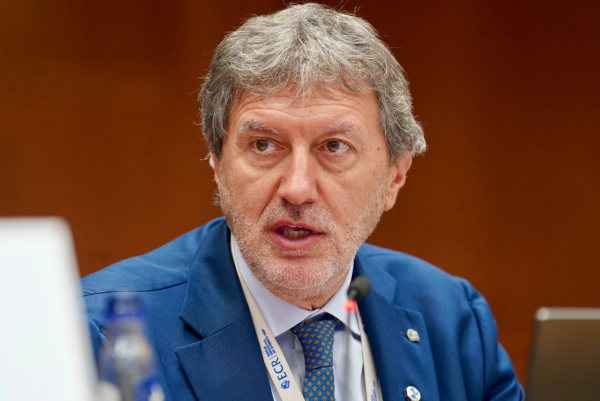
The European Committee of the Regions has adopted an opinion by ECR Group President Marco Marsilio calling for a modern, efficient and resilient European transport system that starts from the concrete needs of territories and avoids creating new divisions between central and peripheral regions.
The opinion, Advancing Europe’s sustainable and connected transport system – a territorial perspective, addresses the Sustainable Transport Investment Plan and the European High-Speed Rail Plan. It sets out a place-based approach combining territorial cohesion, competitiveness, technological neutrality and a stronger role for regional and local authorities.
“European transport policy will succeed only if it starts from the territories and their genuine needs,” Marsilio said. “We cannot build a future transport system by creating new divisions between central and peripheral regions.”
While supporting the expansion of high-speed rail to better connect Europe, reduce journey times and strengthen the Single Market, Marsilio stressed that high-speed infrastructure must develop alongside conventional, regional and local rail networks.
“Connecting Europe means reaching intermediate cities, inland, rural and mountainous areas, and less densely populated territories,” he said. “High-speed rail is essential, but its development must go hand in hand with stronger conventional, regional and local networks.”
High-speed rail cannot work in isolation. The opinion calls for seamless connections with conventional, regional and local rail networks, efficient feeder services, the completion of missing links and investment in first- and last-mile connectivity.
For Marsilio, the right to move and the right to stay are two sides of the same coin. Every citizen must be able to leave to study, work or pursue new opportunities, but no one should be forced to leave because of inadequate connections, services or prospects.
“Guaranteeing widespread and effective mobility means making the freedom to choose where to build one’s future a reality,” Marsilio said. “There can be no right to stay without the right to move. Leaving must be a choice, not a necessity; staying a right, not a privilege.”
The text also underlines the need for more resilient networks and a technology-neutral approach to alternative fuels. The transition towards more sustainable transport must be driven by innovation rather than predetermined technological choices, while remaining economically and socially sustainable and avoiding new strategic dependencies.
Marsilio also called for coordinated European and national investment, realistic rules and a strong role for regions and local authorities in planning and delivering infrastructure. This is essential to ensure that citizens and businesses in every territory can access the same opportunities.
“This opinion proposes a clear political vision: a transport system that strengthens European competitiveness without sacrificing territorial cohesion, supports the transition without penalising less advantaged regions and recognises cities and regions as essential partners,” Marsilio concluded. “The right to move in Europe must make the right to stay a concrete reality.”